
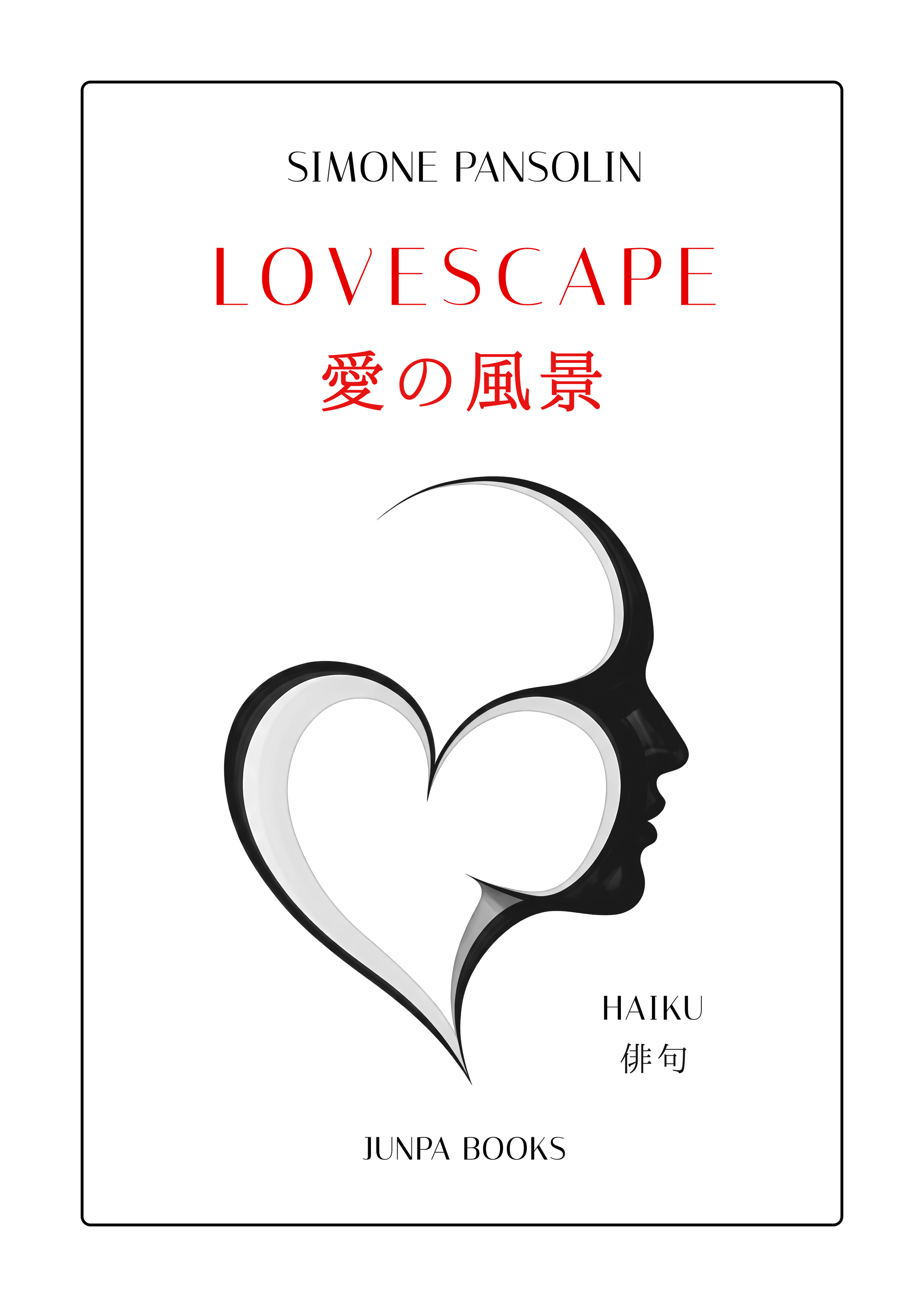
Lovescape
Japan Universal Poets Association, 2025
Traduzioni in giapponese a cura di Mariko Sumikura, in inglese a cura di Jim Kacian
As the title lovescape (a term that is untranslatable in Italian unless we betray and distort its nature) suggests, love is the main theme that runs through this collection of poems. Love as an idea evokes and represents endless meanings and nuances for mankind, in the multiverse of relations with reality, the self and the other. This word single-handedly carries the whole cultural baggage of humanity, which is capable to forge a whole world upon it. Love is a concept that doesn’t hold an absolute meaning, only tangible through the lens of each person’s own reality. Love seems to be (almost) the only aspect of life where the unconscious and the most exposed part of our spirit seem to perfectly align towards a united creative direction.
The act of dedication towards oneself and the other find its voice within both sections that form this collection of modern haikus: ‘Lovescape’ (which lends itself to the name of this whole collection) and ‘Mindscape’, which explores the mental landscape depicted in the mind of human beings. Because even the voluntary act of commitment to one’s subconscious is an act of love in itself.

Pixels
Red Moon Press, 2021
English translations by Jim Kacian
For about a century, Japanese poets have been opening up traditional haiku to new social, cultural, and political-economic themes, giving rise to modern haiku. Over the decades, innumerable formal and content transformations have been introduced. Nowadays, the American publishing house Red Moon Press has a particular focus on the appreciation of these changes.
Pixels, the first full collection of the author’s poetry, fits perfectly into this context. The work contains seventy free-form haiku in Italian, translated into English by the American haiku poet Jim Kacian.

Transfert
Streetlib, 2017
"Simone Pansolin has chosen a challenging title for this collection of his poems. A polysemic word, which suggests multiple meanings, from the one more strictly connected to the psychoanalytic technique and practice to those that refer to any operation of transfer that we can undertake in the artistic, literary, poetic, musical, philosophical, mythological, anthropological, environmental or social field. The basic meaning from which one can start, in order to then discover all the extensions and ramifications of the discourse around it, remains that of transfer, from one subject to another, from one object to another, from the real world to the imaginary world, from presence to memory, from the present to the future."
«It’s an inextinguishable source of gems which are rare in their originality.»
— P. Martino, “La Clessidra”
«A notable achievement expressed in haiku. [...] Pansolin expertly employs this form to condense and distil both the many aspects of love and the mental interior.»
— G. Griffin, poet, writer, and essayist
«A collection of precious poetic gemstones that come together as if encrusted on a royal jewel one after the other and page after page.»
— A. Sacco, "Poesia del Nostro Tempo"
Learn more →
Italian Poetry and Music
Simone Pansolin, Luca Cenisi, Toni Piccini, Valeria Simonova - Cecon, Paola Martino, Giovanna Restuccia.
Music by Simone Fontanelli composed on haiku taken from "Pixels" by Simone Pansolin.
Musical performances by Antonella Bini (flutes).
Host: Elena Capra
Haiku in Translation
la noche en la ciudad:
el hormigón de los edificios
y de la luna
വെളുപ്പ്; കറുപ്പ്:
വാക്കുകൾ
വസ്തുക്കളിൽ കുടുങ്ങിപ്പോയവ
صمت:
الصلاة الوحيدة
المسموعة.
もう愛してないわ
きみの目には
次の無限
вболівальники на стадіоні:
багато вдарів ногами
без м'яча
എല്ലായിടത്തും
എന്റെ നിഴൽ -
ഇരുട്ടിലായത്
行く雲は
形(なり)を残さず
в алмазе
рудник –
хайку